
✍️ Dr. Lokman Khan
Scientist & Educationist
Bradford
27 May 2026
I took my seat at a vantage point in the audience of the Carlisle Centre. I wanted to closely observe every detail. I wanted a clear view of the choreography and the translations while capturing the raw emotions of the performers. The physical distance between my seat and the stage completely vanished the moment the drama started. The emotional intensity of the performance reached to me instantly.
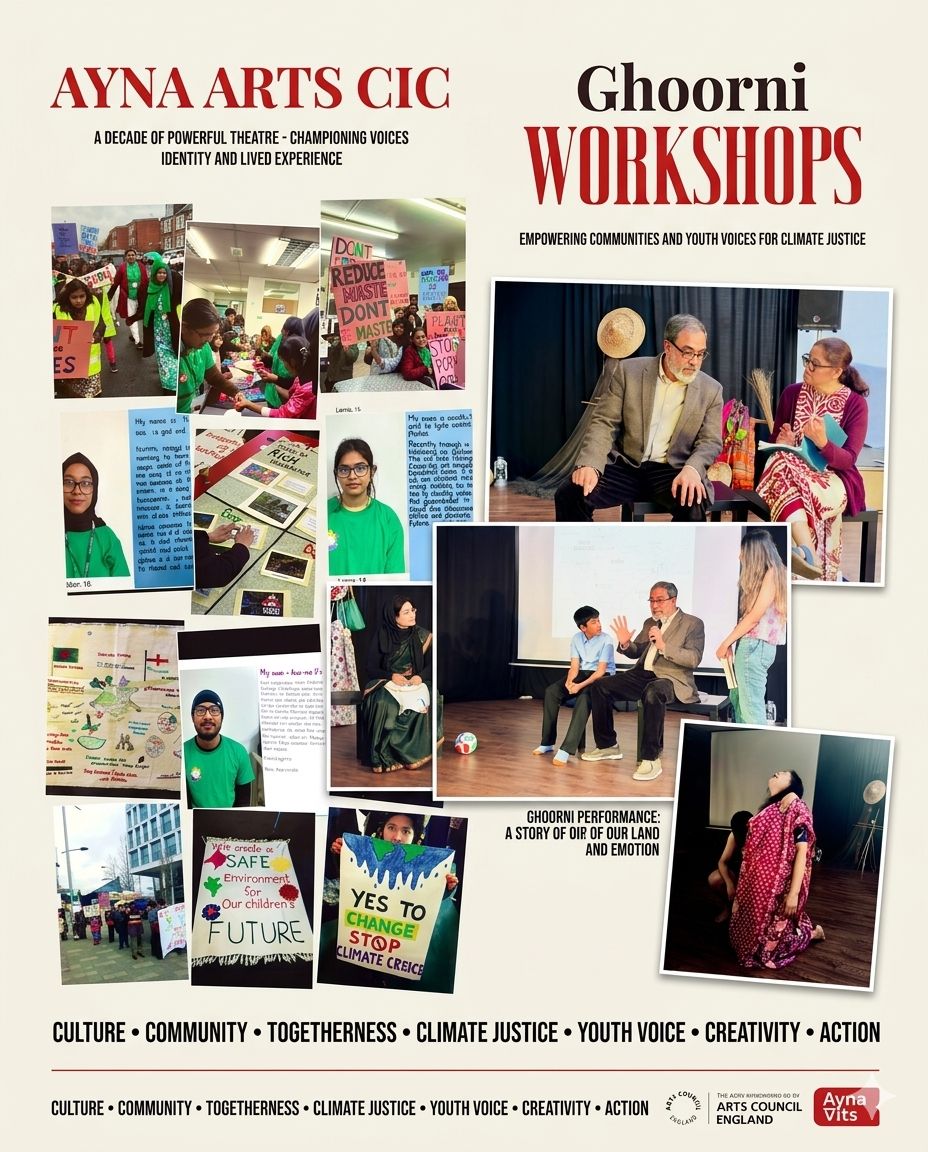
The stage drama GHOORNI is an urgent warning. Playwright Jesmin Chowdhury and director Apu Chowdhury have created an absolute masterpiece. I always do my research before taking my seat in the theater. The journey of this play began four years ago in 2022. Jesmin and Apu were sitting in a Dhaka traffic jam when an email arrived from their friend Kooj Chuhan. He asked if AYNA Arts could participate in a Manchester festival focusing on climate change. Jesmin wanted substance rather than a simple collection of songs. A deep conversation in a British kitchen over tea sparked an intense investigation into global climate injustice.
She researched the devastating 1970 Bhola cyclone. She learned how that natural disaster wiped out millions and fueled the fires of our liberation war. The script evolved from a short thirty minute piece into a full hour of gripping drama. It saw further development in 2024 alongside another play by Tasnim Siddiqa Amin. They eventually secured funding from the Arts Council to finally pay their artists. Yet it remains a beautiful family production. Apu directs and acts. Jesmin writes. Their daughter Ila performs alongside their close circle of friends. I know of no other theater group quite like this.
The story unfolds through the fragmented memories of Ali. He is an immigrant sharing his trauma with a therapist. We see three generations depicted on stage. We see Ali in Bangladesh. We see his children and grandchildren in England. The narrative struck a deep chord in me. I relived my own youth and early adulthood in Bangladesh. I walked the campus of Dhaka University in the early eighties. Watching this play brought those precious memories flooding back to the surface.
I teach advanced chemistry at a college in Sheffield. During my daily train commute from Bradford I often think about the activation energy required to create social change. I spend my days explaining environmental chemistry and the brutal reality of global warming to my students. The science is absolute. If global action fails now, one fifth of Bangladesh will submerge in water. We face rising sea levels and increasingly frequent cyclones.
The play translates this scientific entropy into human agony. Ali escaped a country with a tiny carbon footprint to work in the heavily polluting industries of the UK. The irony is bitter and highly effective. His labour here accelerates the destruction of his home there. I discussed this exact paradox with my students recently. We recognised how the wealth of wealthy nations extracts a devastating toll on developing countries.
The physical production is visually striking. Looking from the audience, I had a perfect macro view of the blocking and set design. The acoustics in the Carlisle Centre carried the music beautifully to the levels without losing any fidelity. Live patriotic and rural Bengali songs beat at the heart of this play. The choreography is brilliant and deeply evocative. They use traditional props like the hukka and the narkel kurani alongside fishing nets. These visual cues coupled with breathtaking live singing made me long for our beautiful lost world.
Apu Chowdhury delivers a flawless performance as Ali. He brings a raw and devastating vulnerability to the stage. His direction is equally sharp. The pacing generally keeps the audience entirely engaged. However I must offer a small professional critique regarding the scene transitions. The shifts between the flashback sequences and the modern therapy sessions occasionally stall the momentum. A slightly quicker lighting cue could maintain the fierce energy of those memories. Yet this is a minor flaw in an otherwise stellar production.
The production goes far beyond mere observation. They include a climate science quiz for the audience. This forces us out of our passive comfort zones. Crossing Footprints acts as the impact producer for this tour. They ensure the message generates real action rather than just applause.
We are completely out of time. The disastrous cycle of GHOORNI is not a theatrical metaphor. It is our impending reality. This is the first theatrical production in the UK to squarely face the climate crisis in Bangladesh. It demands your absolute attention. Go see it for yourselves. Take your foreign friends to the theater to introduce them to our heritage. Celebrate our history and confront our shared future. The storm is already here.






Leave a Reply